
There’s a moment every growing production company eventually faces where the scale of the project no longer matches the size of the company on paper.
For me, that moment happened in 2018. At the time, MJR Visuals was still a relatively small operation. We had built a strong reputation, solid systems, reliable crews, and years of experience producing interviews, conferences, livestreams, and training content. But this conference was different. Different level. Different pressure. Different expectations.
It was the largest conference production I had ever overseen at the time.
One massive keynote room. Up to 15 breakout rooms running simultaneously. Every room required full audio support, microphones, speakers, recording, lighting, staging coordination, and camera coverage. It wasn’t just “show up and film.” It was essentially building a temporary broadcast infrastructure inside a convention center for an entire week. And the truth is, I did not own enough cameras for it. At the time, I only owned around five cameras personally. Everything else had been built through reinvestment over years of work. So to make the event happen, I had to scale fast.
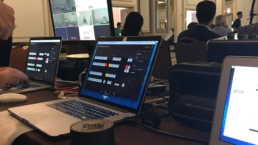
I rented roughly 20 additional cameras from Magnanimous in Chicago. I hired freelancers across multiple departments. Camera operators. Audio crews. Production managers. Setup teams. Breakdown crews. By the time everything was staffed, coordinated, and operational, we had close to 30 or 40 people involved altogether. That experience taught me something important about growth: most companies do not magically become “big.” Sometimes you become big because the opportunity forces you to operate bigger than your comfort zone. And honestly, for the most part, the event went incredibly well. The client was thrilled. Rooms were operational. Livestreams worked. Audio worked. Crews stayed coordinated. Problems got solved quickly. The kind of conference where attendees never fully realize how much controlled chaos is happening behind the scenes to make everything feel seamless. I remember my point of contact joking throughout the week, saying, “That’s my Malcolm,” every time another issue got resolved before becoming visible to the client. By the end of the conference, they were already talking about future events overseas. The Dubai Conference had even entered the conversation.
For a small production company, it felt like crossing into another level.
Then came the interviews. Part of the production involved filming dozens of sit-down interviews throughout the week. Around 65 interviews total. Most running roughly 45 minutes each. For that portion of the project, I hired a veteran freelancer with decades of experience in production. Old-school television background. The type of person whose résumé immediately commands respect. And almost immediately, we disagreed creatively. The disagreement was over lighting and color temperature. My philosophy has always been simple: protect the image first. If footage is slightly cold, you can warm it up later in post-production. Modern workflows give you flexibility. You preserve detail. You preserve highlights. You preserve skin texture. But once footage becomes too hot, once highlights clip, once skin tones lose information, there is only so much recovery possible afterward. Audio works the exact same way. Once audio clips, it clips forever. But his philosophy came from an older generation of production where the goal was to make footage look “finished” directly out of camera. Warm tones. Bright image. Minimal color correction later. He kept insisting the image would look too blue otherwise. I disagreed.
But eventually, I deferred to his experience. And that decision stayed with me for years.
Because when the conference ended and we began reviewing footage, every single interview came back too hot. Every one. I remember sitting in post-production sick to my stomach because I already knew what had happened before I even opened half the files. We salvaged what we could. We corrected what we could. We delivered professionally. But the footage never became what it should have been. And we did not get the following year’s contract. Now, to be clear, I do not tell this story to blame someone else. Leadership does not work that way. At the end of the day, the responsibility was mine because I allowed myself to abandon my own workflow instincts simply because someone else had more years of experience. That conference taught me one of the most important lessons of my career: Experience and accountability are not the same thing. Someone can have more years in the industry and still not understand your workflow, your standards, your delivery expectations, or the realities of modern post-production. Especially if they are not the person sitting in the edit afterward trying to recover the footage. And as your company grows, this becomes one of the hardest parts of leadership. People will constantly try to override your instincts with confidence, titles, résumés, or authority. Sometimes they are absolutely right. Sometimes they know far more than you in specific areas. But leadership also means knowing when not to abandon the systems and instincts that helped you win the contract in the first place. Ironically, that conference became one of the most important growth moments of my career.
Not because it was flawless. But because it proved something to me. A small production company could absolutely operate at a national conference level if the systems, preparation, and leadership were strong enough. And more importantly, I learned this: